
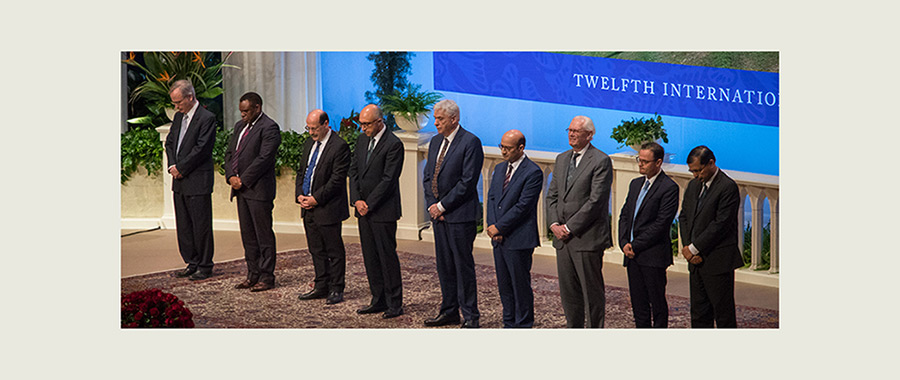
The Universal House of Justice, a pivotal institution within the Bahá’í Faith, stands as a paragon of democratic governance and spiritual leadership. Elected through a carefully delineated process, this institution embodies principles of consultation, unity, and justice. Understanding its significance necessitates a profound exploration of its election, function, and impact on the Bahá’í community and beyond.
The election of the Universal House of Justice occurs every five years, marking a significant occasion for Bahá’ís worldwide. This process eschews traditional political campaigns, wherein candidates vie for popularity through rhetoric. Instead, Bahá’í elections operate under a unique framework grounded in spirituality and collective decision-making. The absence of nominations and electoral competition is a deliberate choice, aimed at fostering an environment where the guidance of the Divine can be discerned through the community’s collective consciousness.
Candidates for the Universal House of Justice are chosen based on their understanding of the Bahá’í teachings, their ability to articulate a vision for the future, and their demonstrated commitment to service. This approach engenders a crucial paradigm shift from conventional political paradigms, wherein the emphasis is often placed on individual ambition and charisma. In stark contrast, the Bahá’í method prioritizes collective wisdom over personal gain, aiming to promote unity and coherence within the community.
The process of election is rooted in extensive consultation, whereby the electorate engages in elevating discussions about the candidates. Such discourse reflects a communal commitment to spiritual growth and the pursuit of justice. During this phase, Bahá’ís are encouraged to reflect deeply on the qualifications of their potential representatives, instilling a sense of responsibility that transcends mere voting. Each participant is invited to voice their perspectives, enabling a multifaceted examination of the candidates’ abilities, ultimately fostering a profound sense of investment in the outcome.
Once elected, the Universal House of Justice bears the heavy responsibility of guiding the world’s Bahá’í community. This institution not only addresses immediate needs but also provides a coherent framework for the application of Bahá’í principles to contemporary issues. An essential function of the House is the promulgation of laws, which are derived from the teachings of Bahá’u’lláh, the founder of the Bahá’í Faith. These laws serve to advance social and spiritual wellbeing, addressing matters ranging from marriage to community service.
Moreover, the Universal House of Justice operates on the principle of transparency, ensuring that its decisions and directives are communicated clearly to the global community. This openness cultivates trust and confidence among Bahá’ís, reinforcing their commitment to the decisions made by their elected representatives. In an age where mistrust towards governing bodies is prevalent, this distinct attribute of the Universal House of Justice signifies a profound commitment to accountability and integrity.
At its core, the existence of the Universal House of Justice epitomizes a transformative approach towards leadership. Instead of wielding authority over its constituents, the House actively seeks to empower individuals, fostering an environment where everyone has a voice. This democratic ethos is reflective of a broader vision in which the principles of unity and justice permeate social structures, thereby instilling hope for a more equitable future.
One cannot overlook the House’s role in fostering interfaith dialogue and collaboration. By engaging with leaders of various religious traditions, the Universal House of Justice exemplifies a commitment to mutual understanding and cooperation. In an increasingly fragmented world, such endeavors serve not only to promote the Bahá’í perspective but also to stimulate broader discussions on justice, peace, and the interconnectedness of humanity.
The moral compass provided by the Universal House of Justice extends further than mere advocacy; it actively engages in the intricacies of global challenges. Climate change, poverty, and inequality are addressed through the lens of Bahá’í principles, which emphasize the interdependence of all people. By responding proactively to these issues, the House reiterates its commitment to serving not only the Bahá’í community but humanity as a whole, reflecting an understanding that the welfare of one is intrinsically linked to the welfare of all.
Furthermore, the House promotes an educational framework that inspires a continuous pursuit of knowledge. Programs aimed at moral and intellectual development are fostered, laying the groundwork for future generations to engage thoughtfully with the manifold complexities of modern life. This emphasis on education underscores a steadfast belief in the transformative power of knowledge, which is seen as a catalyst for change within both the individual and the society at large.
Perhaps one of the most intriguing aspects of the Universal House of Justice is its acknowledgment of the evolving nature of truth. The understanding that spiritual truths unfold progressively, adapting to the exigencies of society, resonates deeply within the Bahá’í doctrine. This perspective invites all individuals to remain curious, to seek knowledge unrelentingly, and to embrace the ongoing journey of discovery.
In conclusion, the election and function of the Universal House of Justice encapsulate a remarkable paradigm of governance that challenges conventional expectations of leadership. Its founding principles of justice, unity, and consultation offer a distinctly spiritual approach to contemporary governance, inviting adherents and observers alike to contemplate the true essence of democracy and collective progress. As the Bahá’í community continues to navigate the complexities of the modern world, the Universal House of Justice remains a beacon of inspiration, guiding its followers towards a vision of a united and harmonious global society.