
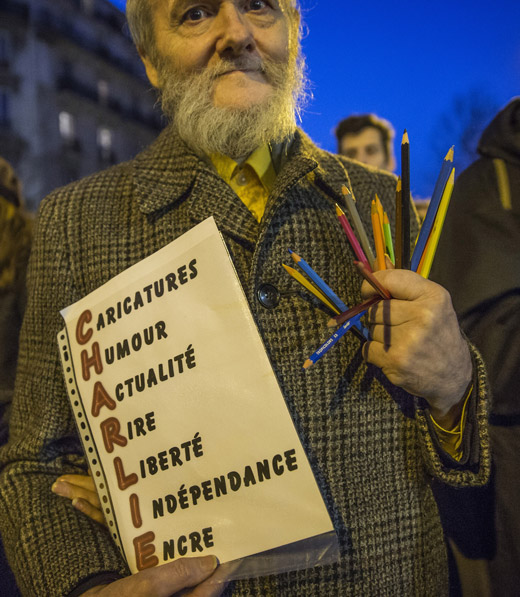
The discourse surrounding the tragic events that transpired in Paris, embodied by the phrase “Je Suis Charlie,” juxtaposes the sanctity of free expression against the reverence afforded to spiritual figures, particularly within the context of religious teachings. This intersection poses profound questions about what is sacred and how individuals and societies navigate the complex terrain of freedom and respect. The Baha’i teachings provide a compelling framework for examining these ideas through the lens of unity, tolerance, and the intrinsic value of every human being.
At its core, the phrase “Je Suis Charlie” became a rallying cry for those advocating for freedom of speech—a fundamental human right as enshrined in various legal frameworks around the globe. However, the ardent defense of such freedoms can sometimes lead to conflicting interpretations regarding what constitutes respect for the sacred. In the Baha’i worldview, such contrasts necessitate a reflective dialogue aimed at a deeper understanding of human purpose and interconnectedness.
To explore these themes, it is essential to unravel the concept of the sacred. In many religious traditions, sanctity is assigned to figures, texts, and symbols that embody divine attributes or truths. When examining the Prophet Muhammad, Muslims consider him as the embodiment of divine message, a revered individual whose life and teachings provide profound insights into ethical living. To caricature such figures is not merely a matter of artistic expression; rather, it can represent an affront to the deeply held beliefs of millions, leading to discord and misunderstanding.
This juxtaposition of artistic license and respect for the sacred elicits a plethora of ethical considerations. In an era dominated by rapid information exchange, it becomes increasingly necessary to cultivate a society that values dialogue over diatribe, fostering an environment where differing beliefs can coexist harmoniously. Herein lies a central pillar of Baha’i teachings: the principle of unity in diversity. The recognition of diverse beliefs and practices, while honoring the fundamental oneness of humanity, allows for a more nuanced discussion of sacredness.
Within this paradigm, the Baha’i Faith advocates for an expansive view of what it means to be human. Humans are viewed not just as individuals but as integral parts of a larger mosaic. This perspective encourages an ethos where various expressions of individual belief are acknowledged and respected. In this light, the idea of what is sacred transcends mere symbols or personalities; rather, it encompasses the sanctity of human dignity and the intrinsic worth of every individual.
The Baha’i teachings further emphasize the necessity of a deep-seated respect for all religions. This respect manifests not only in our treatment towards religious leaders but also towards the beliefs of their adherents. Seeking to understand rather than to provoke allows for a more profound connection with others, fostering empathy and compassion in our interactions. It is about drawing from a wellspring of shared human experience to bridge ideological chasms. This shared humanity serves as both a testament to our interconnectedness and a call to greater moral responsibility.
Furthermore, the complexity of contemporary issues such as freedom of speech and religious reverence necessitates a re-evaluation of how expressions of dissent are framed. Are we merely asserting our right to critique, or are we engaging in a quest for understanding? Challenging the sacred through satire or majoritarian narratives can often lead to a dilution of the very freedoms that one endeavors to uphold. True courage lies not solely in provocative discourse but in the ability to provoke thought and inspire dialogue.
Incorporating the Baha’i perspective allows for a reframing of the conversations surrounding the implications of “Je Suis Charlie.” It advocates for an approach that recognizes the multifaceted nature of beliefs, allowing for criticisms that propel humanity towards greater enlightenment without veering into mockery or disrespect. The teachings espoused by Baha’u’llah, founder of the Baha’i Faith, promote a vision of society where respect for diverse beliefs is paramount, melding freedom of expression with conscientious engagement with the sacred.
This ideology of respect is not merely an idealistic endeavor but a practical necessity for fostering global peace. The collective acknowledgment of diversity paves avenues for mutual understanding, enabling societies to navigate the often tumultuous waters of belief with equanimity. It invites individuals to not only stand for their beliefs but also to listen deeply to the beliefs of others, thereby enhancing the richness of human experience.
In conclusion, the conundrum posed by the expression “Je Suis Charlie” in relation to the reverence afforded to prophetic figures is emblematic of a broader discourse on what constitutes the sacred in our increasingly interconnected world. The Baha’i teachings offer an invaluable reorientation towards valuing dialogue, understanding, and unity in diversity. As societies grapple with the ramifications of free expression and the pursuit of truth, the path illuminated by the principles of respect and empathy will undoubtedly be the hallmark of a more enlightened and compassionate global community. Ultimately, it is through this lens that humanity can aspire to a harmonious coexistence, where respect for that which is sacred extends beyond individuals, resonating within the very fabric of our collective human experience.