
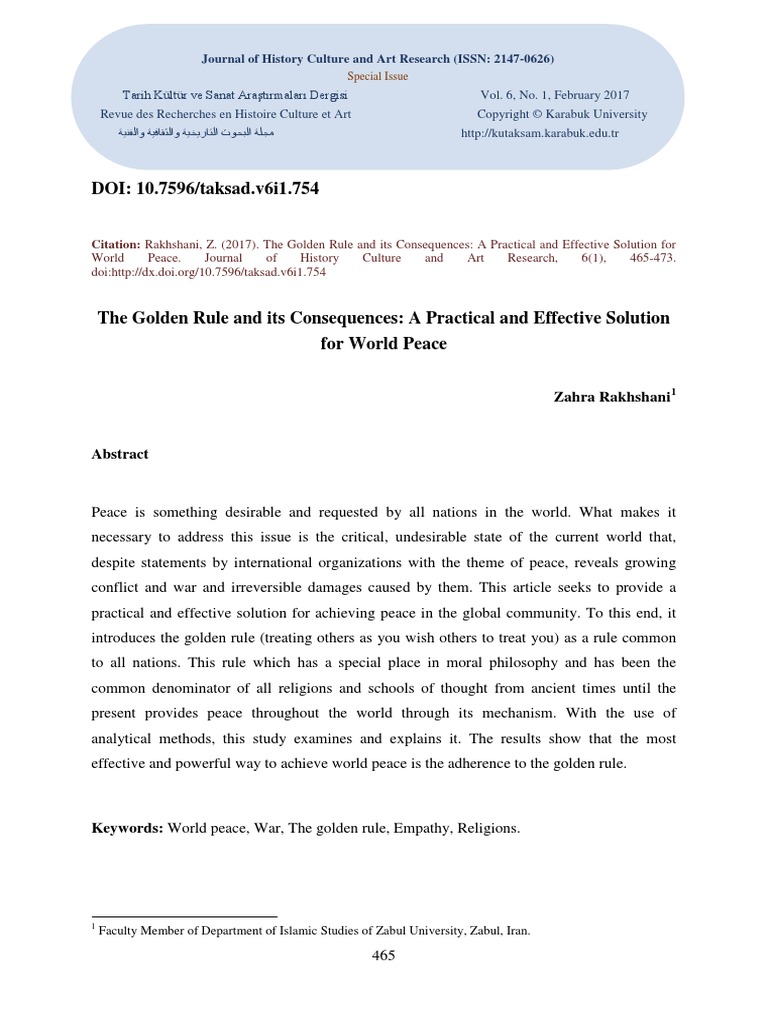
In the realm of spiritual inquiry and moral philosophy, the teachings of the Bahá’í Faith offer rich insights into the intricacies of gender relations and universal ethics. Central to Bahá’í doctrine is the Golden Rule, a perennially relevant maxim that articulates an essential tenet of social conduct: treating others as one would wish to be treated. When applied to the context of gender equity and the status of women, this principle not only underlines the inherent dignity of all human beings but also propels a transformative dialogue regarding women’s rights and roles within both religious and secular frameworks.
The Bahá’í teachings advocate for the equality of women and men, proposing that this fundamental equality is integral to achieving global unity and peace. Abdu’l-Bahá, the son of the founder of the Bahá’í Faith, enunciated that equality between genders transcends mere legal rights; it pertains to the very essence of human identity. This radical perspective compels a profound reconsideration of traditional narratives surrounding women’s capabilities and roles within society. There is an inherent insistence that any culture or system that subjugates half its population, whether through discrimination or exclusion, undermines its own collective potential.
To appreciate the Bahá’í approach to women and the Golden Rule, it is imperative to delve into several interconnected themes that elucidate this relationship. Firstly, the ethical framework established by the Golden Rule propounds the idea of empathy as a cornerstone of moral development. Empathy engenders an understanding that transcends individual experiences, allowing one to recognize the shared humanity among all. This empathy is necessary for articulating the struggles and aspirations of women globally, who have historically been marginalized.
The notion of justice—a pivotal concept in Bahá’í thought—further aligns with the Golden Rule’s essence. Justice, in this context, is not merely a legalistic notion but rather a transformative principle that advocates for the fair treatment and inclusion of all individuals. A society that practices the principle of treating others as they would wish to be treated inherently prioritizes justice. Consequently, the advancement of women’s rights becomes a moral imperative rather than a peripheral issue. The complexities of gender dynamics can thus be reframed through the lens of justice; advocating for women’s empowerment not only elevates the status of women but also enriches societal structures as a whole.
Moreover, the application of the Golden Rule within the Bahá’í framework necessitates an introspective examination of one’s attitudes and behaviors towards women. The principle admonishes individuals to question their biases and systemic privileges, challenging the status quo that often relegates women to subordinate roles. By encouraging adherents to cultivate an awareness of their own privileges, the Bahá’í teachings dismantle the barriers that have historically obstructed progress toward gender equality.
In addition, the Golden Rule serves as a clarion call for the establishment of educational equity. The Bahá’í Faith places a strong emphasis on the importance of education for both genders. Education is not only a transformative force for personal development; it also acts as a catalyst for social change. Educated women are more likely to contribute to their communities and pursue paths of leadership. This empowerment is essential to creating societies that uphold the dignity and rights of all individuals.
As the Bahá’í teachings assert, the participation of women in all aspects of life is essential for the progress of humanity. This claim resonates with the operationalization of the Golden Rule, which necessitates inclusivity as a core value. By valuing diverse contributions and perspectives—particularly those of women—societies can harness a greater collective wisdom, leading to more equitable and sustainable solutions to pressing global challenges.
Nevertheless, to fully implement the visions espoused by the Bahá’í teachings, both men and women must actively engage as allies in the quest for equality. The Golden Rule enjoins men to not only advocate for women’s rights but to embody these values in their own lives, becoming champions for justice and equity. This partnership between genders fosters a more profound understanding and respect for one another’s experiences, creating a more harmonious and equitable world.
The implications of the Bahá’í perspective on women and the Golden Rule extend beyond the confines of individual relationships; they reverberate through the very fabric of society. When one takes seriously the commitment to treat others with dignity and respect, it prompts a reevaluation of societal norms and practices that have historically oppressed women. The ripple effect can lead to legislative reforms, cultural shifts, and grassroots movements that advocate for a more just and equitable society.
Ultimately, the integration of the Golden Rule into the discourse surrounding women’s rights within the Bahá’í Faith encapsulates a profound promise: the potential for a paradigm shift. Such a shift invites individuals and communities alike to embrace the fundamental equality of women and men, forging pathways toward unity and peace. The Bahá’í teachings beckon us to commit ourselves to this course of action, fostering a profound curiosity in how our individual and collective practices can contribute to a reimagined, equitable world where the Golden Rule is realized in its fullest sense. Transformative change is not only possible; it is essential for the flourishing of humanity.