
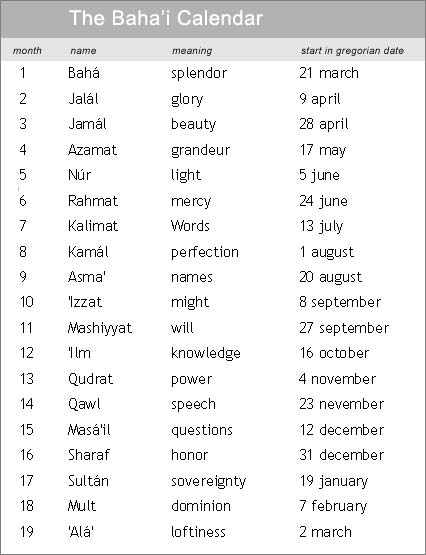
The Baha’i calendar, a unique system that governs the spiritual and social activities of the Baha’i community, is deeply intertwined with the faith’s teachings and practices. Central to this temporal framework are the Intercalary Days, a distinctive feature that invites contemplation and offers profound insights into the nature of time, spirituality, and community. This exploration into the Baha’i calendar and its intercalary period promises a shift in perspective, encouraging individuals to perceive time not merely as a linear progression but as an opportunity for spiritual renewal and communal engagement.
To understand the Baha’i calendar, one must first recognize its foundation. Comprising 19 months, each consisting of 19 days, this calendar represents a departure from conventional timekeeping methods. The Baha’i month, known as a “Bahá,” symbolizes unity and comprehensiveness, aligning the faithful with the teachings of Baha’u’llah, the founder of the Baha’i Faith. The cyclical nature of this calendar underscores an intrinsic connection to the divine; it serves as a reminder that time is not an isolated phenomenon but interwoven with the soul’s journey.
However, the 361 days of the Baha’i calendar necessitate a mechanism to account for the additional days of the solar year. Herein lies the significance of the Intercalary Days, or “Ayyám-i-Há.” These days, which are inserted between the months of a’ and ‘Ala’, serve several profound purposes that extend beyond mere chronology.
Firstly, the Intercalary Days are a time of hospitality and charity. The Baha’i teachings emphasize the importance of community and the bonds that unite humanity. During these days, Baha’is are encouraged to engage in acts of kindness and generosity, transcending the individualistic focus that often pervades modern society. This period challenges followers to embody the spirit of detachment and selflessness, mirroring the teachings of Baha’u’llah. It fosters a climate conducive to love, service, and interaction within communities, prompting individuals to reflect on their responsibilities to others.
Moreover, the Intercalary Days are an opportunity for spiritual reflection and rejuvenation. In a world that often prioritizes material achievements over spiritual growth, these days prompt believers to re-evaluate their spiritual practices and aspirations. They serve as a reminder that amidst the hustle of daily life, moments of contemplation are essential. Baha’is may dedicate time to prayer, meditation, and learning, reinforcing the idea that spiritual development remains a lifelong pursuit.
The significance of the Intercalary Days extends to the preparation for the upcoming period of fasting, observed during the month of ‘Ala’. This transition underscores the importance of self-discipline, self-reflection, and internal growth. One may view the Ayyám-i-Há as a buffer, a grace-filled space that allows individuals to reflect on their spiritual journeys and ready themselves for the fasting period ahead. The momentary respite before a period of heightened spiritual endeavor offers an essential contrast that enriches the overall experience of the faithful.
The permissibility of festivities during the Intercalary Days also enhances their significance. Baha’is are encouraged to celebrate this time with joy, fostering a sense of unity and engagement within their communities. Festivities may include communal gatherings, shared meals, and other forms of collective celebration. This infusion of vibrancy and connection seeks to invigorate bonds among followers and create an atmosphere of joy and gratitude. It encourages believers to acknowledge life’s simple pleasures while remaining conscious of their obligations to others within their communities, ensuring the balance between personal enjoyment and collective responsibility.
On a deeper level, the existence of Intercalary Days highlights an essential teaching within the Baha’i Faith: the flexibility of religious practice. The temporal structure of the calendar is an acknowledgment of the ever-changing nature of human experiences and the need for adaptability in spiritual observances. This understanding encourages Baha’is to embrace a diverse range of rituals and practices, underscoring that faith can manifest in myriad forms tailored to the individual and the community. This adaptability ultimately enriches the collective Baha’i experience.
Additionally, the contemplation of the Baha’i calendar and the Intercalary Days encourages curiosity about the intersection of spirituality and time. Time, often perceived as a rigid construct, is revealed to be fluid and multifaceted within this framework. This perspective invites an exploration into how various cultures and religions perceive and mark time, igniting a dialogue about the broader implications of cyclical versus linear time systems. This exploration transcends the Baha’i community, inviting all to consider the spiritual dimensions of their temporal experiences.
In conclusion, the Baha’i calendar and its Intercalary Days encapsulate a rich tapestry of spiritual, social, and temporal significance. It beckons adherents to delve deeper into the essence of time, engaging not only with the routine aspects of life but also with an elevated sense of purpose and connection. By embracing the themes of altruism, reflection, celebration, and adaptability, believers find themselves positioned at the nexus of personal and communal growth. The teachings of the Baha’i Faith are thus not confined to abstract ideals but are woven into the very fabric of daily existence, inviting all to a profound transformation that transcends mere timekeeping—prompting a reimagining of what it means to journey together through the cycles of existence.
